Hair Type Chart: How to Find Your Curl Pattern
Use this hair type chart to read your pattern from 1A to 4C, check porosity, density and strand thickness, and get simple care tips for each hair type.
By the Beauty Sassy editors7 min read
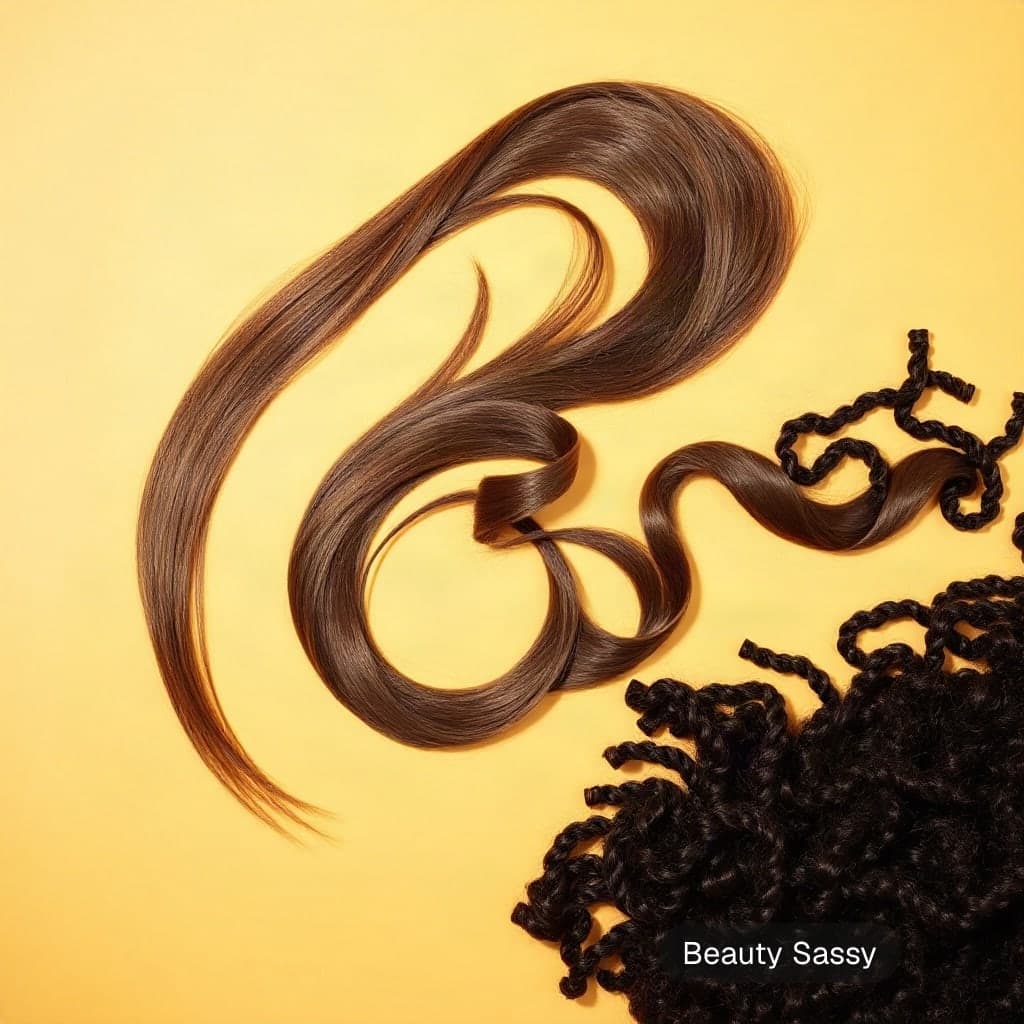
A hair type chart sorts hair by curl pattern into four families: type 1 is straight, type 2 is wavy, type 3 is curly and type 4 is coily. Each family splits into A, B and C, from the loosest to the tightest pattern, so 2A is a soft wave and 4C is a very tight coil.
Curl pattern is only part of the picture. Porosity, density and strand thickness shape how your hair behaves just as much. This guide walks through all of it, then gives you practical care tips for each family.
What are the 4 hair types on the chart?
The four types describe the shape a strand takes when it dries with nothing in it. The more a strand bends and twists, the higher the number.
- Type 1, straight: hair falls flat from root to tip with no real bend.
- Type 2, wavy: hair forms a loose S shape, usually starting below the ears.
- Type 3, curly: hair forms defined loops or ringlets you could wrap around a finger or marker.
- Type 4, coily: hair forms tight coils or zigzags, often with lots of shrinkage.
What does type 1 straight hair look like (1A to 1C)?
Type 1 hair has no natural curl. It tends to look shiny because scalp oil travels down the straight strand easily, which also means it can get greasy fast.
- 1A: very fine, pin straight and soft. It often struggles to hold a curl or volume.
- 1B: straight with a little body, especially at the ends.
- 1C: straight but coarser and thicker, with a slight bend and some frizz in humidity.
What is 2A, 2B and 2C wavy hair?
Wavy hair bends into an S shape without forming full loops. It is the type people most often mistake for straight hair that is just frizzy.
- 2A: loose, barely there waves that are easy to brush straight. The top often lies flat.
- 2B: clearer S waves that start around mid length, with some frizz at the crown.
- 2C: deep, defined waves that start near the root, sometimes with a few loose ringlets mixed in. 2C hair is often thick and prone to frizz.
What are 3A, 3B and 3C curls?
Type 3 hair forms true spiral curls that spring back when you stretch them. The letter tells you how wide each curl is.
- 3A: big, loose loops, roughly the width of a thick sidewalk chalk stick.
- 3B: bouncy ringlets about the width of a marker.
- 3C: tight corkscrews about the width of a pencil or straw, packed closely together with lots of volume.
What is 4A, 4B and 4C hair?
Type 4 hair coils tightly and can shrink to a fraction of its stretched length. It is often the most fragile type because each bend in the strand is a weak point.
- 4A: tight, springy S coils about the width of a crochet needle, with visible definition.
- 4B: sharp Z shaped bends instead of round coils. Hair looks fluffy and the pattern is less defined.
- 4C: very tight zigzags that are hard to see without styling. Shrinkage is high, often more than 70 percent of its stretched length.
How do you find your hair type?
Wash your hair, skip all products, and let it air dry fully without touching it. Then look at the pattern in a few different spots.
- Wash with a gentle shampoo and a light conditioner, then rinse well.
- Squeeze out water with a soft T shirt or towel. Do not rub or brush.
- Leave it alone until it is completely dry. No gel, cream, heat or hands.
- Check strands at the crown, the nape and around your face. Compare their shape to the descriptions above.
- Note the tightest and loosest patterns you see. Many heads have both.
If your hair is heat damaged or chemically straightened, the pattern you see may not be your natural one until healthy hair grows in.
What is hair porosity and how do you test it?
Porosity is how easily your hair absorbs and holds moisture. It is low, medium or high, and it often matters more for product choice than curl pattern.
- Low porosity: the cuticle lies flat. Water beads up, hair takes a long time to get wet and dry, and products tend to sit on top.
- Medium porosity: hair takes in moisture easily and holds it reasonably well.
- High porosity: the cuticle is raised or damaged. Hair soaks up water fast, dries fast and gets frizzy and dry easily.
The popular float test drops a clean strand into a glass of water. Floating is said to mean low porosity and sinking high. Treat it with caution. Oils, product residue, water temperature and surface tension all change the result. A better check is how your hair acts day to day: how long it takes to get soaked in the shower and how quickly it dries.
What are hair density and strand thickness?
Density is how many strands grow on your head. Thickness, sometimes called width, is how wide each single strand is. They are separate things.
- Density: part your hair in a few places. If you see a lot of scalp, density is low. If you barely see any, it is high.
- Thickness: roll one strand between your fingers. If you can barely feel it, it is fine. If it feels like thread, it is medium. If it feels wiry, it is coarse.
You can have fine strands with high density or coarse strands with low density. Fine strands usually need lighter products. Coarse strands can handle richer ones.
How should you care for each hair type?
Straighter hair usually needs more frequent washing and lighter products. Curlier hair usually needs fewer washes, more moisture and gentler handling.
Straight hair care (type 1)
- Wash every day or two if your scalp gets oily.
- Look for lightweight conditioners and volumizing sprays. Apply conditioner to the ends only.
- Avoid heavy oils and butters near the roots, which can weigh hair down.
Wavy hair care (type 2)
- Wash two or three times a week.
- Look for light leave in conditioners, foams and mousses that add hold without weight.
- Scrunch product in while hair is wet, then air dry or use a diffuser on low.
- Avoid brushing dry waves, which breaks them into frizz.
Curly hair care (type 3)
- Wash once or twice a week, and consider rinsing with conditioner between washes.
- Look for creamy leave in conditioners, curl creams and gels. Layering them from thinnest to thickest works like layering skincare.
- Detangle only when hair is wet and full of conditioner, using your fingers or a wide tooth comb.
- Avoid harsh sulfate shampoos if your curls feel dry.
Coily hair care (type 4)
- Wash every week or two, and deep condition regularly.
- Look for rich creams, butters and oils to seal moisture in after a water based leave in.
- Protective styles like braids, twists and buns reduce daily handling.
- Sleep on a satin or silk pillowcase or wrap your hair to cut friction.
Whatever your type, a healthy scalp comes first. If flakes or itch are getting in the way, sort that out before chasing curl definition. When you read hair product labels, the same habits from our clean makeup guide help you spot what you want and what you would rather skip. Dry, tight skin along the hairline can benefit from the same basics in our dry skin treatment guide.
Can you have more than one hair type?
Yes, and most people do. It is common to have looser waves on top and tighter curls at the nape, or a mix of 3C and 4A across your head.
Hair can also change over time with hormones, age, medication, damage and climate. Use the chart as a guide to start choosing products and routines, not a rule you have to fit. How your hair feels and responds matters more than the label.
Questions people ask
What is the most common hair type?
There is no reliable count of hair types across the population, so be wary of anyone who quotes one. Straight, wavy, curly and coily hair are all common, and many people fall between two types.
Can your hair type change?
Your pattern can shift over time. Hormonal changes such as pregnancy or menopause, aging, some medications and heat or chemical damage can all loosen or tighten your curls.
Is 2C hair wavy or curly?
2C sits at the edge of the two. It is classed as wavy because most of it forms S waves, but it often has some loose ringlets, so many 2C heads do well with curly hair techniques.
Does hair type decide which products you should use?
It is a useful starting point, but porosity, density and strand thickness often matter more. Fine 3A curls may need lighter products than coarse 2C waves, for example.
Liked this lifestyle story?
Get the next one first
One email a week: new stories and the few products worth buying.