Face Shapes: How to Find Yours and Work With It
Find your face shape in five minutes with a mirror and tape, then learn what oval, round, square, heart, diamond and oblong mean for contour, brows and hair.
By the Beauty Sassy editors7 min read

To find your face shape, pull your hair back, face a mirror straight on, and compare four measurements: forehead width, cheekbone width, jaw width and face length. Which one is widest, and whether your jaw is rounded, angular or pointed, tells you which of the six common face shapes you have: oval, round, square, heart, diamond or oblong. Most people lean toward one shape with a touch of another, and that is completely normal.
How to find your face shape step by step
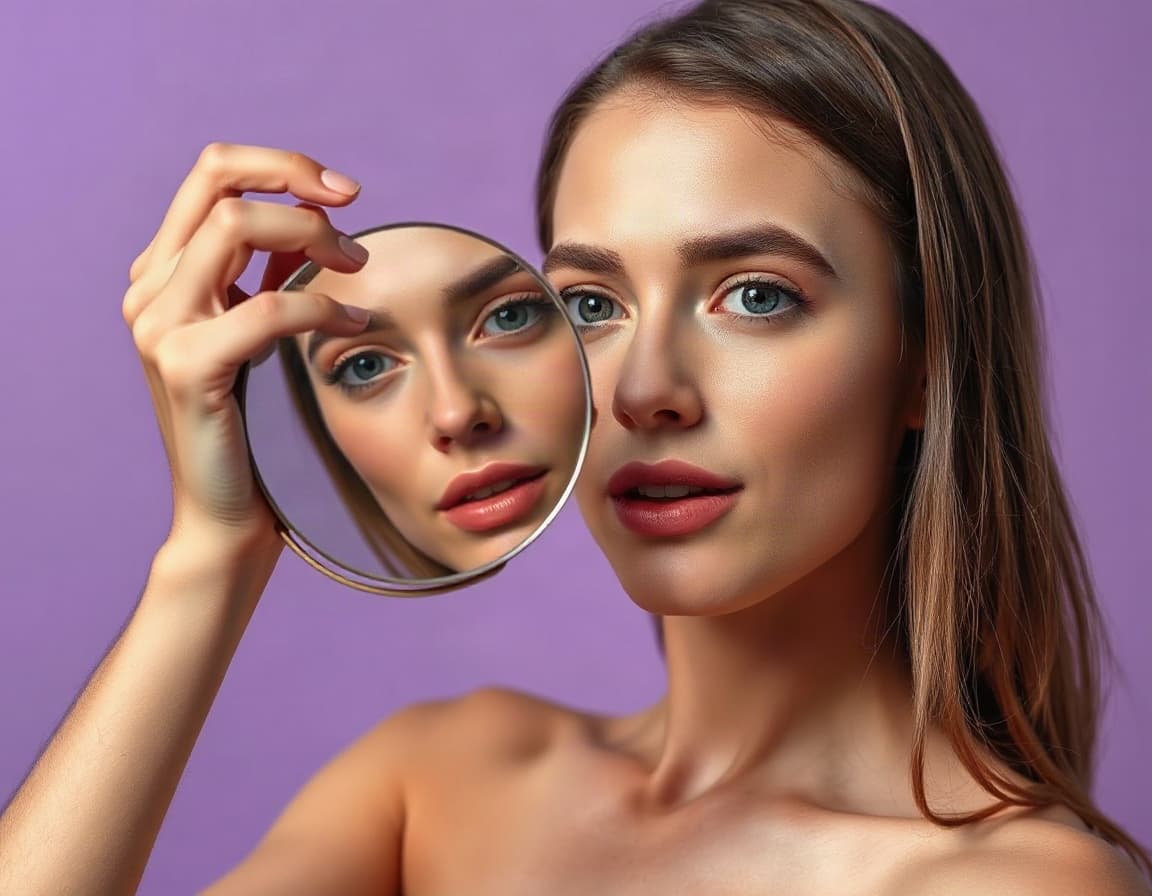
You need a mirror, a soft measuring tape or a length of string, and good, even light. Daylight from a window in front of you is ideal. Overhead bathroom light throws shadows that make cheekbones and jaws read sharper than they are.
- Get your hair off your face. Use a headband or clips. Bangs hide your hairline, and your hairline is part of the answer.
- Keep your chin level. Tilting down shortens the face in the mirror. Tilting up stretches it.
- Measure your forehead. Go straight across at the widest point, roughly halfway between your brows and hairline.
- Measure your cheekbones. Find the highest point of each cheekbone, just below the outer corner of each eye, and measure across.
- Measure your jaw. Find the angle of your jaw below each ear and measure straight across from one to the other.
- Measure your face length. Go from the center of your hairline down to the tip of your chin.
- Look at your jaw. Note whether it curves softly, turns a sharp corner, or narrows to a point at the chin.
No tape handy? Trace your outline on the mirror with an old lipstick or a dry-erase marker, then step back. The outline is often more honest than your memory of your own face.
The six face shapes, explained
Oval
Your face is longer than it is wide, about one and a half times as long. Your forehead is slightly wider than your jaw, and the jaw curves softly. Oval faces are balanced, so the goal is to keep that balance rather than correct anything.
Round
Length and width are close to equal. Your cheekbones are the widest point, and your jaw curves with very little angle. Cheeks tend to look full from the front.
Square
Forehead, cheekbones and jaw are all roughly the same width, and your jaw turns a clear corner below the ear. Length is close to width. Square faces photograph with strong structure.
Heart
Your forehead is the widest point. Cheekbones sit slightly narrower, and your jaw tapers to a smaller, sometimes pointed chin. Many heart faces have a widow's peak at the hairline.
Diamond
Your cheekbones are clearly the widest point. Forehead and jaw are narrower and close to each other in width, and the chin is often pointed. Diamond faces have very defined cheekbones without any contour at all.
Oblong or rectangle
Your face is noticeably longer than it is wide, and forehead, cheekbones and jaw are similar in width. If your jaw corners are soft, you are oblong. If they are angular, you are closer to rectangle. The advice for both is nearly the same.
Contour for your face shape
Contour is a shadow. You place it where you want a feature to recede, so the shade should be about two steps deeper than your skin with a neutral or slightly cool cast, because real shadows are not orange. If you are unsure which cast suits you, start with your skin tone and undertone before you buy anything. Bronzer is a different job: it adds warmth where the sun would hit.
- Oval: A light stroke just under the cheekbone is enough. Stop roughly in line with the outer corner of your eye so the shadow does not drag your face downward.
- Round: Angle the contour slightly upward, from the top of the ear toward the corner of the mouth, stopping mid-cheek. Add a soft touch at the temples and just under the jaw near the ear. You are adding angles, not trying to shrink your face.
- Square: Shade the corners of the jaw and blend down onto the neck so there is no line. A little at the outer corners of the forehead softens the top half to match.
- Heart: Shade the temples and along the sides of the forehead toward the hairline. Keep cheek contour short and high, and go very light at the chin.
- Diamond: Keep cheek contour soft and close to the bone, since your cheekbones already lead. A little highlight at the center of the forehead and on the chin adds width where the face narrows.
- Oblong: Shade along the top of the forehead at the hairline and just under the tip of the chin to shorten the face. Run cheek contour more horizontally than diagonally.
A small, dense, angled brush gives you control and blends without moving your base. Our guide to makeup brushes covers which shapes are worth owning.
Brow shapes for each face shape
Brows frame the upper third of your face, so a small change in arch height reads as a big change in proportion. Work with your brow bone first. Then use these as nudges, not rules.
- Oval: A soft, gently angled arch keeps things balanced.
- Round: A higher arch with a defined peak adds length. Very rounded brows echo the roundness of the face.
- Square: A softly curved arch balances a strong jaw. Brows that are too thin or too straight can look severe next to sharp angles.
- Heart: A rounded, low to medium arch keeps attention off the width of the forehead.
- Diamond: A curved brow with a soft peak, and a tail that extends slightly, adds width at the temples.
- Oblong: A flatter, straighter brow that extends a little outward makes the face read wider and shorter.
To map any brow, hold a pencil vertically against the side of your nose: that is where the brow starts. Angle it through the outer edge of your iris while you look straight ahead: that is the arch. Angle it from your nostril through the outer corner of your eye: that is where the tail ends.
Hair framing that suits your face shape
Round faces look longer with length past the chin, a side part, and layers that begin below the jawline. A little volume at the crown helps. Chin-length cuts that curve inward repeat the roundness.
Square faces soften with layers, waves around the jaw and side-swept bangs. A blunt bob that ends exactly at the jaw corner draws a line across your widest point.
Heart faces balance well with chin-length or longer cuts that carry fullness near the jaw. Side bangs break up the width at the forehead.
Diamond faces do well with fullness at the forehead and chin, such as a soft fringe or a lob with movement at the ends. Tucking hair behind your ears shows off your cheekbones.
Oblong faces shorten with bangs and width at the sides. Very long, straight hair with height on top makes the face look longer.
Oval faces can wear most cuts. Let your hair texture and how much styling time you have make the call.
Where blush fits in
Blush placement shifts with face shape too, but it works differently from contour because it adds color and lift rather than shadow. We cover that in detail in where to put blush for your face shape, so use it alongside this guide. When you put it all together, the everyday routines in our makeup looks guide show how contour, brows and blush work in a finished face.
Common mistakes when reading your face shape
- Measuring with your hair down. Hair changes the outline you see, especially at the forehead and jaw.
- Confusing fullness with shape. Soft, full cheeks do not automatically mean a round face. Look at where the bone is widest and how the jaw turns.
- Forcing a single label. If you sit between two shapes, borrow from both. The labels are a starting point.
- Overcorrecting. Face shape is a guide for placement, not a flaw to erase. Heavy contour that fights your structure looks muddy up close.
Questions people ask
Can your face shape change over time?
Your bone structure stays fairly steady as an adult, but changes in weight and the gradual loss of facial volume with age can shift how your shape reads. It is worth rechecking every few years.
How do I tell a round face from a square face?
Look at your jaw. Both shapes are about as wide as they are long, but a round face curves smoothly from ear to chin, while a square face turns a clear corner below the ear.
Do I need contour if I have an oval face?
No. Oval faces are already balanced, so contour is optional. A light stroke under the cheekbone adds definition for photos or evening, but skipping it is perfectly fine.
What if my face is two different shapes?
That is very common. Pick the shape that matches your widest point and jaw, then borrow techniques from the second shape where they help. Trust what looks right in the mirror over any chart.
Liked this makeup story?
Get the next one first
One email a week: new stories and the few products worth buying.